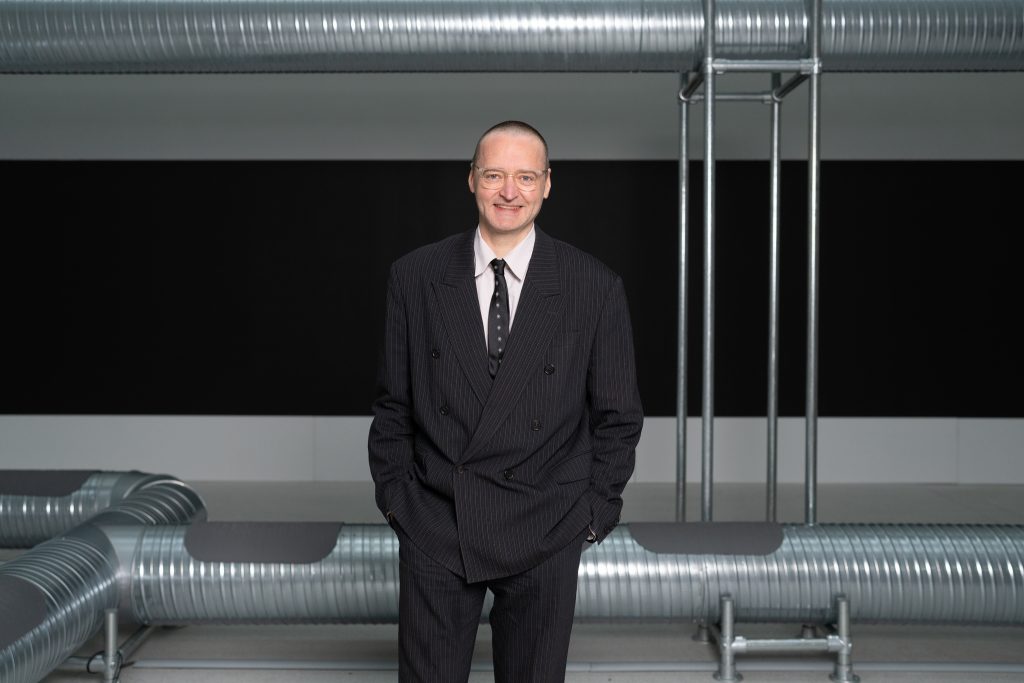
On Thursday, 30 April, the Contemporary Art Centre (CAC) in Vilnius (Vokiečių St. 2) opens the international group exhibition ‘Superglue, or Inventing the Friend’. Curated by Valentinas Klimašauskas – a curator and writer who took up the directorship of the CAC a year ago – the exhibition marks the beginning of his programme and offers an insight into the future direction of the institution.
Located in the Old Town of Vilnius, the CAC has long been perceived in different ways: for some, its modernist architecture has felt austere; for others, it has offered a contemplative environment in which exhibitions can be experienced in calm surroundings; for others still, it may even have created a certain tension, as the meaning of some works does not immediately reveal itself. The new exhibition seeks to demonstrate that the institution is open, presenting its programme in an accessible way to audiences of all ages – from the youngest to the oldest – while engaging them in different ways.
As the opening approaches, the exhibition’s curator reflects on the changes taking place at the institution, what visitors can expect from the exhibition, and the events that will accompany it.
You’ve been leading the Contemporary Art Centre for a year now. When you took up the position, you inherited the institution’s programme shaped by your predecessor, Kęstutis Kuizinas, which concluded with the exhibition ‘Bells and Cannons: Contemporary Art in the Face of Militarisation’. The upcoming exhibition ‘Superglue, or Inventing the Friend’ will be the first in your programme as director. I’d like to begin by asking about your vision for the institution. What has already begun to change during your first year, and what directions do you see for the future?
Valentinas Klimašauskas: As a curator, and now as the head of this institution, I strongly believe in engaging with context. Since the CAC has been – and at times still is – criticised for the blinding whiteness and coldness of its modernist interior, as well as for the perceived opacity of contemporary art more broadly, even a certain air of arrogance, one of the key words in my initial vision was generosity: generosity of attention towards the audience, generosity in the provision of information, a more generous visitor experience, better working conditions within the institution, and so on. Only after taking up the role did I realise how difficult it is to realise this promise of – due to insufficient funding, constant staff overwork, my own inexperience, shifting funding priorities, the broader polycrisis, and other pressures.
Despite this – or perhaps in response to the difficulties and cataclysms of the present – the question arises of what contemporary art can offer in such a world. To what extent can we, as one of the historically significant institutions in the region, engage with the processes shaping the world and society? What can we offer – means of negotiation or mediation, or simply a space for being and reflecting together? In this sense, the CAC’s vision is, first and foremost, to become an institution that can be trusted both by those who work within or alongside it and by our audiences. This is a long, slow, and at times painful process, in which the greatest change must come from within – from the CAC itself. It is an old truth: vision and change begin with oneself.
At first glance, the title of the upcoming exhibition, ‘Superglue, or Inventing the Friend’, suggests themes of connection, closeness and relationships. What is the exhibition really about, and what can visitors expect from it? Will it differ in any way from previous CAC exhibitions? If so, what would be the key difference?
V. K.: The upcoming exhibition, at least formally, opens a new chapter in the history of the CAC, as it marks the beginning of my exhibition programme as director. ‘Superglue, or Inventing the Friend’ is conceived as a sincere gesture – perhaps even a somewhat naïve invitation to rethink the function of contemporary art and its role in today’s dramatically troubled world.
One of the exhibition’s distinguishing features is a stronger emphasis on figurative art, through which we aim to fill all the CAC’s exhibition spaces – almost like visitors at an opening. I would like to believe that this generosity of figurative works will give visitors the opportunity to find something that resonates with them and to form new relationships with contemporary art.
Continuing our conversation about the exhibition, I’d like to turn to one of its key works – a 1968 film by Algirdas Araminas, When I Was a Child, an excerpt of which will be shown in collaboration with the Lithuanian Film Centre. What is the connection between this film and the CAC? And how does a film made in the past enter into dialogue with the contemporary works presented in the exhibition?
V. K.: Without diminishing the other works in the exhibition, it’s fair to say that this particular piece was the starting point for the exhibition. It includes an excerpt from the film When I Was a Child, shot in our spaces a year after the then Vilnius Exhibition Palace – now the CAC – opened in 1967.
The scene shows a group of secondary school students on a guided tour of the 1968 ‘Republican Exhibition of Applied and Decorative Arts’. I hope this excerpt will function as something like a dizzying journey through time, prompting us to return to the memory and history of both the institution and art itself. Contemporary art, I think, has itself already become a historical phenomenon – something that may now require a new name and a new way of approaching it.
Judging from this episode, modernist art was already facing similar tensions between so-called high art and a wider public. In the film, the students run away from the exhibition – the vitality of youth overtaking the formal language of modern art. This scene feels relevant not only to us, but to other art institutions as well, as it raises questions about why exhibitions repel, and why audiences – then as now – avoid or even flee them. What is it that alienates or intimidates our viewers? And, perhaps more importantly, in the context of this exhibition and the CAC’s broader vision, what might help us to become friends in a time of fragmentation and polarisation?
Incidentally, one of the works shown in the film – Vida Gruzdaitė’s textile piece Meeting (1967) – has been successfully located and will be included in the exhibition. Notably, it features a horse alongside two human figures – a motif that also appears in the film excerpt, symbolising the unconscious, vitality, and unrestrained passions and emotions.
The exhibition is international, bringing together artists from Lithuania and abroad. Could you share which familiar names audiences will see, and whose work might be presented in Lithuania for the first time?
V. K.: As the curator of the exhibition, I find all the works included in it valuable, inspiring, and worthy of the audience’s time – otherwise they would not be there. Since its central piece is an excerpt from a 1968 film, the exhibition does not shy away from historical artists and their works; after all, part of our ever-changing audience is likely encountering them for the first time.
Looking chronologically, I would highlight several works: Antanas Sutkus’s early, previously unshown photographs from the series School for the Blind (1962); Eglė Rakauskaitė’s video work Faces (1998–1999), originally presented in the first Lithuanian Pavilion at the Venice Biennale; frescoes and paintings created especially for the exhibition by the Ukrainian artist Kateryna Lysovenko; the large-scale, breathing kinetic installations by Pakui Hardware; Rebecca Ackroyd’s dreamlike yet realistic sculptures; photographs engaging with queer themes by Janina Sabaliauskaitė, Volungė Aušra Griškonytė, Katsiaryna Miats and Karol Radziszewski; Maty Biayenda’s textile works addressing the experiences of Black trans people; and Pol Taburet’s neo-Afro-Romantic sculptures. At least half of the artists in the exhibition haven’t previously been shown in Lithuania – among them are young, emerging, overlooked and lesser-known names, as well as artists who have for some time been shaping art scenes across Europe and beyond.
Exhibitions at the CAC are often accompanied by a public programme, including artist talks, guided tours and workshops for young people. What kind of public programme is planned for this exhibition?
V. K.: I’ll start with the opening events. I’d like to remain critical of the traditional culture of openings at larger institutions. Already in the 1990s, the art critic Rosalind Krauss criticised the cultural logic of so-called late capitalism, under which major museums began to bow to global liquid capitalism and its material and immaterial forms. Ideally, opening events should not further fragment our audience into new hierarchies, but rather ‘glue’ it together and open up possibilities for new encounters.
For this reason, we’re trying to create a more open space this time – one that brings our community together. On the opening day, this will be initiated by the Vilnius-based artist Malka Sultan together with students from the Vilnius Academy of Arts. They’re creating a performative situation reminiscent of different community street atmospheres – an all-day shared lunch or dinner titled Community Streets. We’ll also be collaborating with Radio Vilnius: their DJs will take care of the day’s music and conversations, and we’re hoping for at least a couple of live performances – though for now, let that remain a surprise.
Later, during this year’s Lithuanian LGBTQ+ Pride week in early June, we are tentatively planning a joint event with the Lithuanian Interdisciplinary Artists’ Association (LTMKS). The programme will include a screening of the film Julia (dir. Jackie Baier, 2013), about a trans woman from Klaipėda, as well as a performative reading of a text written for Julia by the artist Agnė Jokšė. The evening will continue with a performance by the Polish artist Filipka Rutkowska, addressing themes of working-class background, migration, sexuality, education and artistic practice.
Another important gesture of openness for the CAC is the sharing of curatorial knowledge. As an institution with a distinctive curatorial history in the region, we plan to organise open portfolio review days every couple of months, where artists who register in advance can meet with our curatorial team and discuss a range of artistic and curatorial questions. We hope such practices will continue, helping the institution to open up further and, returning to the earlier question of vision and future, to become more genuinely generous.
The opening of the exhibition ‘Superglue, or Inventing the Friend’ at the Contemporary Art Centre (Vokiečių St. 2, Vilnius) will take place on Thursday, 30 April, from 12:00 to 23:00, with events unfolding throughout the day. The opening is free and open to all. The exhibition will be on view until 6 September, accompanied by a programme of events running across its duration. Further details are available on the CAC website.