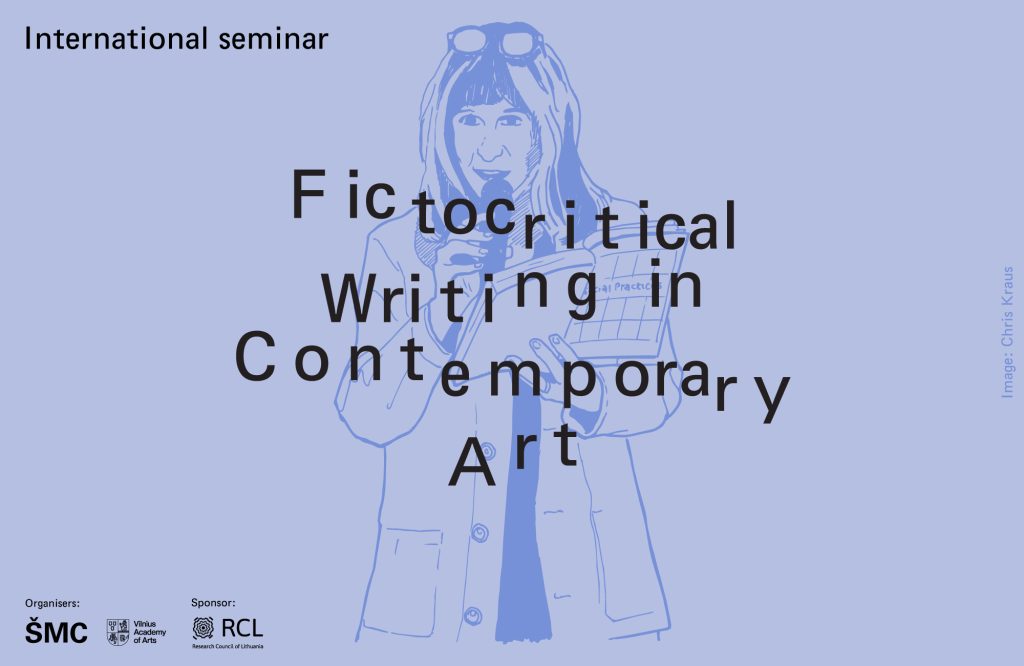
On Tuesday 24 November from 2 p.m. to 6 p.m., the Contemporary Art Centre (CAC) Reading Room will hold Fictocritical Writing in Contemporary Art, an international seminar co-organised by the Contemporary Art Centre and the Vilnius Academy of Arts (VDA), convened by David Maroto as part of his postdoctoral research project at VDA, Fictocritical Encounters: Rethinking Criticality and Writing in Contemporary Art. The seminar brings together leading practitioners and experts to discuss, drawing on their own experiences, how fictocritical writing contributes to the production of knowledge and the creative possibilities it offers within contemporary art.
The status of critical art writing is being fundamentally called into question. Recent years have seen a growing consensus that the language typically used to write about contemporary art has become exhausted – a mode of writing increasingly perceived as inadequate to meaningfully address current artistic practices. This shift is reflected in ongoing debates surrounding the crisis of art criticism, the phenomenon of International Art English, and growing calls to reassess curatorial prose.
Fictocritical writing is a transdisciplinary approach that seeks to blur the boundaries between the fictional, the factual, and the theoretical, challenging conventional distinctions between fiction and criticism, fiction and non-fiction, and research and literature. It produces a form of knowledge that is situated, embodied, and rooted in subjectivity. As a mode of experimental writing, it holds significant potential to reinvigorate contemporary critical art writing.
Chris Kraus, author of novels such as I Love Dick and Aliens & Anorexia, will discuss her fictocritical approach to art criticism as a character situated and embedded within a social subgroup: the art world. She will share her writing methods, reflecting on how she brings the qualities of fiction into her work as an art critic and achieves critical rigour through fiction. Kraus will also reflect on her experience in academia, asking: Can fictocritical writing be taught? How can it be assessed?
Through a series of group exhibitions in Paris, curator Sinziana Ravini has developed the concept of the ‘exhibition-novel’, which treats the exhibition space as a narrative structure, populated by protagonists and antagonists, and animated by hidden subplots. Drawing on her background as a psychoanalyst and art critic, Ravini will present her curatorial and editorial methods, showing how she interweaves personal stories, psychoanalytic concepts, and literary structures into the fabric of group exhibitions, transforming artists into characters and exhibition texts into forms of narration.
David Maroto will be in conversation with Valentinas Klimašauskas to discuss the concept of the curator’s novel as a means of expanding the experience of artworks beyond the exhibition itself, with a particular focus on Klimašauskas’ own curator’s novels and how they merge fiction and imagination with curatorial writing. What happens when creative writing techniques are introduced into curatorial practice? What impact does the curator’s novel have on institutions? How does it change the spectator’s perspective?
These questions will serve as starting points for a seminar that examines how approaches traditionally associated with creative writing can be employed in critical enquiry within the visual arts.
The seminar will be held in English. Admission is free.
PROGRAMME
13:30 Doors open
14:00–14:15 Welcome by Edvardas Šumila (CAC) and Prof. Vytautas Michelkevičius (VDA)
14:15–15:00 David Maroto: Fictocritical Encounters (keynote lecture)
15:00–15:45 Sinziana Ravini: What Does It Mean for an Exhibition to Have a Plot? (lecture)
15:45–16:00 Coffee break
16:00–16:45 Valentinas Klimašauskas in conversation with David Maroto: Telebodies and Other Curators’ Novels
16:45–17:30 Chris Kraus: Personal and Critical Writing (lecture, online)
17:30–18:00 Roundtable discussion and Q&A with all speakers
18:00 Closing reception
CHRIS KRAUS is a writer, critic, and filmmaker. Her books of art and cultural criticism have been translated into eighteen languages, including Aliens and Anorexia, Where Art Belongs, and Social Practices. Her first novel, I Love Dick, was adapted for television. Kraus is a co-editor of the independent press Semiotext(e). She currently teaches at Deep Springs College in the Sierra Nevada, California.
Dr DAVID MAROTO is a Spanish visual artist, writer, and researcher. Together with curator Joanna Zielińska, he is the co-founder of The Book Lovers, a research project on the artist’s novel. He is currently a postdoctoral fellow at Vilnius Academy of Arts, where he is undertaking a project entitled Fictocritical Encounters: Rethinking Criticality and Writing in Contemporary Art, funded by the Research Council of Lithuania (LMTLT), agreement No. S-PD-25-23.
Dr SINZIANA RAVINI is a curator, writer, and psychoanalyst based in Bucharest. She teaches theory at Sorbonne University and is editor-in-chief of the Swedish Art magazine Paletten. She is also the author of several curator’s novels, including The Black Moon and Aphrodisia, among others.
Dr VALENTINAS KLIMAŠAUSKAS is a curator, writer, and director of the Contemporary Art Centre (CAC) in Vilnius. He has curated exhibitions at the Venice Biennale and the Baltic Triennial. He is also the author of several curator’s novels, including B and/or an Exhibition Guide in Search of Its Exhibition and Telebodies: Bleeding Subtitles for Postrobotic Scenes.