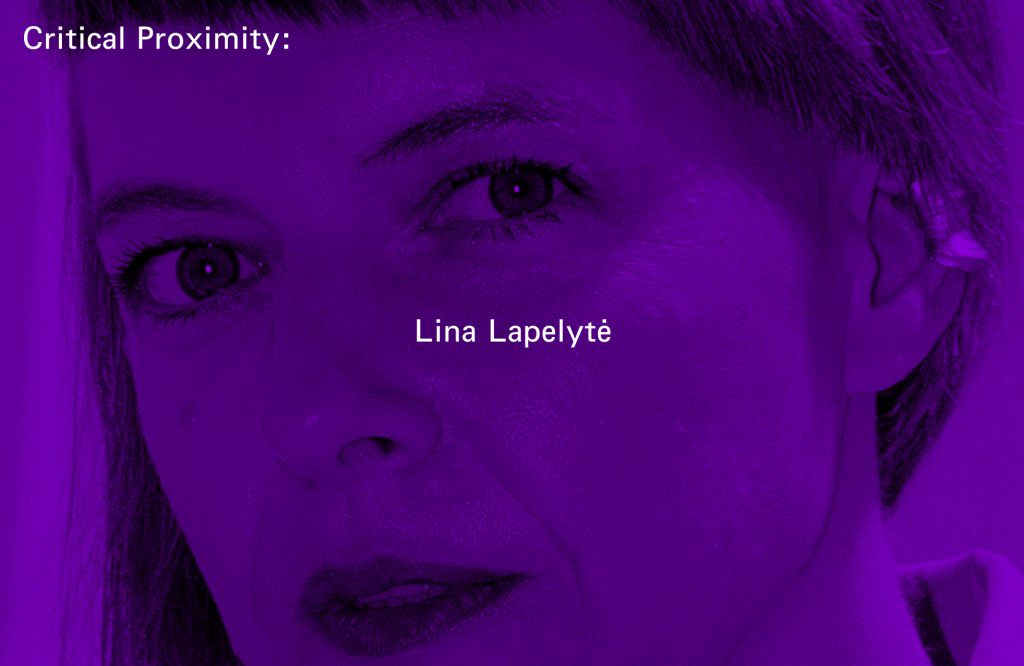
On Thursday, 17 December, at 6 pm, the Contemporary Art Centre (CAC) Reading Room will host the fifth event in the public talks and lecture series ‘Critical Proximity’. The guest is artist and composer Lina Lapelytė, whose solo exhibition ‘Gatherings’ is currently on view at the CAC.
The artist has titled this evening ‘Questions for Alessandro’. A few months ago, while working on Mud Works in Milan, Lina was invited to take part in a public conversation with the Italian choreographer Alessandro Sciarroni. The two artists moderated the conversation themselves. Rather than focusing on the finer points of their work, they explored the autobiographical and psychological experiences that gave rise to it and continue to shape it.
At the ‘Critical Proximity’ event, Lina Lapelytė will put the questions she prepared for Alessandro to herself, seeking to understand what a naive question might open up. This offers another way of approaching the premise of the ‘Critical Proximity’ series: an artist in conversation with her own work, offering insight into her thinking without the mediating gaze of a critic, curator or viewer.
The event takes place during Lina Lapelytė’s solo exhibition ‘Gatherings’ (curated by Virginija Januškevičiūtė and Aistė Liuka Jonynaitė), on view at the CAC until 10 January 2027. For the first time, the exhibition brings together in one space works from different periods of her practice that explore the relationships between voice, music, performance, and listening. These works invite people who have been told they have no ear for music to sing, asking whose voices are heard and who sets the rules of harmony.
The event will be held in Lithuanian.
Admission is free, but places are limited, so please arrive early.
LINA LAPELYTĖ (b. 1984, Kaunas) is an artist, composer and performer who lives and works in Vilnius and London. She studied classical violin at the Lithuanian Academy of Music and Theatre, followed by sound art, and in 2013 completed an MA in Sculpture at the Royal College of Art, London. Her performance-based practice is rooted in music and draws on pop culture, opera, folk rituals, and everyday life, often involving non-professional performers and communities. Together with Rugilė Barzdžiukaitė and Vaiva Grainytė, she created the operas Have a Good Day! (2011) and Sun & Sea (Marina) (2017). The latter represented Lithuania at the 58th Venice Biennale, won the Golden Lion in 2019, and has since been shown in more than thirty countries. Lapelytė’s work has been presented at Haus der Kunst, Munich; Brooklyn Academy of Music, New York; Tai Kwun, Hong Kong; Fondation Cartier and Lafayette Anticipations, Paris; MACBA, Barcelona; and the Serpentine Galleries, London. In 2026, she presented Serendipity Island at Tate Modern, London. She received the Lithuanian National Prize for Culture and Arts in 2019.
The ‘Critical Proximity’ series invites us to reflect on the discourses and themes that inevitably accompany contemporary art. Against the backdrop of today’s crises, contemporary art is inseparable from the circumstances in which it emerges, and these circumstances become an important factor in how it is perceived and the influence it has. These range from the physical and material conditions in which art exists to the technologies and social dynamics that permeate everyday life – not just art – and reveal how authority and legitimacy are determined. They also encompass crisis itself, which has become not merely a rupture in the flow of history but a permanent feature of the contemporary world. These questions emerge through what is created, exhibited, and discussed. In this series, which also marks the general direction of the Contemporary Art Centre’s public programme, we invite people to engage, understand and reflect together.
Contemporary art here serves as a vehicle for discussing the contemporaneity in the broadest sense – a concept that philosophers such as Giorgio Agamben and Peter Osborne theorise, each in their own way, as a ‘present’ that does not coincide with itself. For Osborne, the contemporary is a structure in which individual moments do not coalesce into a whole, and the present is sustained solely by this fictitious construct, which is inevitable under the conditions of globalisation. For Agamben, contemporaneity is instead a position in which we remain at odds with the present by perceiving not only its light but also its darkness – in other words, by engaging with contemporaneity through a critical relationship.
In light of these dynamics, the title of the series also alludes to the modernist assumption that a critical distance is necessary for the perception of art. This assumption can no longer be accepted at face value: there is nowhere left to step back to. What we might wish to observe from the outside also affects us – we are critically close. Bruno Latour proposed ‘critical proximity’ as an alternative to distance, arguing that a gaze from nowhere is not a condition of objectivity, but rather its loss. This reversal becomes significant in the context of this series too: proximity is not a choice, because war, climate change and other crises are also critically close, regardless of how we think about them. We therefore invite you to choose how we might inhabit this proximity while retaining the distance necessary to reflect critically upon it.
The guests in this series will include practitioners – artists and curators – and theorists, as well as representatives from other fields who work with different aspects of the contemporary world, including technology, ecology and current political forms. While discussing each guest’s practice in specific terms, the series will situate it within broader contexts of agency, legitimacy, responsibility and power. Consequently, the series is not limited to the field of art alone; the questions it raises will extend into other parts of the Contemporary Art Centre’s public programme, including lectures, educational initiatives and reading room activities.
Edvardas Šumila
Photography and/or filming may take place at the event, so please be informed that you may be seen in photos and/or videos of the event. These photos and videos can be published on social networks or media.