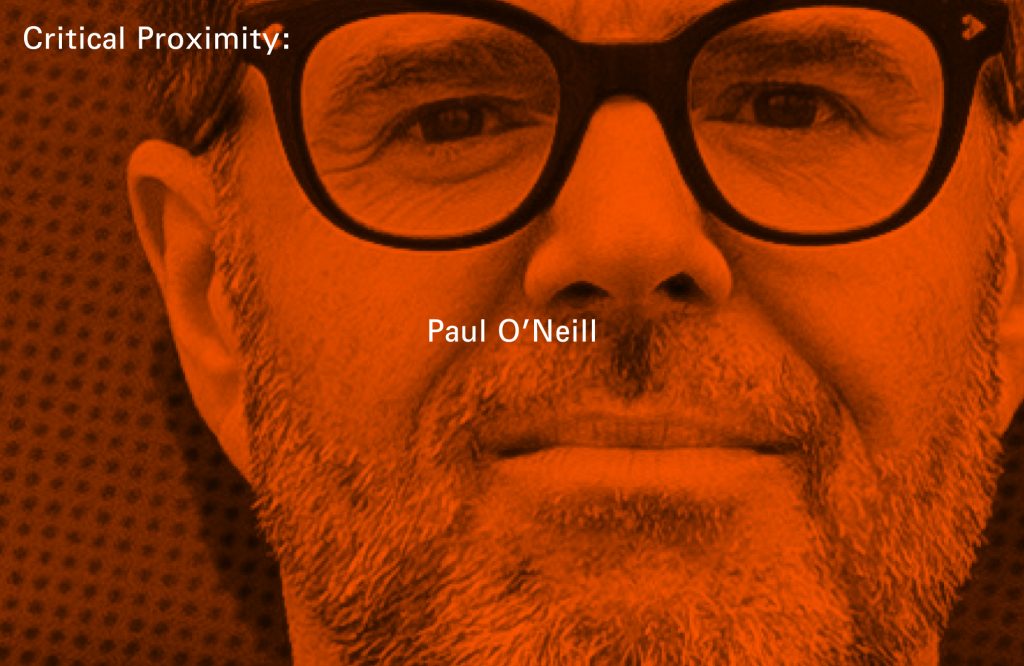
On Thursday, 5 November, at 6 pm, the Cinema Hall of the Contemporary Art Centre (CAC) will host the third event in the public talk and lecture series ‘Critical Proximity’. Irish curator, artist, writer and educator Paul O’Neill will present his latest book, Beyond Caring: Para-hosting as Curatorial Escape.
What can established art institutions learn from the approaches to invitation, hosting and publicness adopted by small-scale organisations? In the book, O’Neill explores how new forms of invitation can reimagine host–guest relations and open up escape routes from fixed institutional roles. Moving between speculation, critique and proposition, he introduces ‘para-hosting’ as a cooperative methodology of generosity and self-organisation without absorption: a form of escape that enables transformative possibilities beyond existing power structures, both within and beyond institutions.
The event will consist of a talk of a 30-minute talk, with readings from the book accompanied by images, followed by a conversation with the audience.
The event will be moderated by philosopher and curator Edvardas Šumila and will be held in English.
Admission is free, but places are limited, so please arrive early.
PAUL O’NEILL is Artistic Director of PUBLICS, a curatorial agency, contemporary art commissioner, and event and exhibition space with a dedicated library in Helsinki. Between 2013 and 2017, he was Director of the Graduate Program at the Center for Curatorial Studies (CCS), Bard College, New York. He has co-curated over 80 exhibitions worldwide, and the Paul O’Neill Archives (1993–2024) are held in the collection of the Irish Museum of Modern Art in Dublin. He is the author of The Culture of Curating and the Curating of Culture(s) (MIT Press, 2012), which has been translated into many languages, and co-editor of the trilogy of curatorial anthologies The Curatorial Conundrum, How Institutions Think and Curating After the Global, published by MIT Press. In 2027, he will co-curate Survival Kit 18 in Riga.
The ‘Critical Proximity’ series invites us to reflect on the discourses and themes that inevitably accompany contemporary art. Against the backdrop of today’s crises, contemporary art is inseparable from the circumstances in which it emerges, and these circumstances become an important factor in how it is perceived and the influence it has. These range from the physical and material conditions in which art exists to the technologies and social dynamics that permeate everyday life – not just art – and reveal how authority and legitimacy are determined. They also encompass crisis itself, which has become not merely a rupture in the flow of history but a permanent feature of the contemporary world. These questions emerge through what is created, exhibited, and discussed. In this series, which also marks the general direction of the Contemporary Art Centre’s public programme, we invite people to engage, understand and reflect together.
Contemporary art here serves as a vehicle for discussing the contemporaneity in the broadest sense – a concept that philosophers such as Giorgio Agamben and Peter Osborne theorise, each in their own way, as a ‘present’ that does not coincide with itself. For Osborne, the contemporary is a structure in which individual moments do not coalesce into a whole, and the present is sustained solely by this fictitious construct, which is inevitable under the conditions of globalisation. For Agamben, contemporaneity is instead a position in which we remain at odds with the present by perceiving not only its light but also its darkness – in other words, by engaging with contemporaneity through a critical relationship.
In light of these dynamics, the title of the series also alludes to the modernist assumption that a critical distance is necessary for the perception of art. This assumption can no longer be accepted at face value: there is nowhere left to step back to. What we might wish to observe from the outside also affects us – we are critically close. Bruno Latour proposed ‘critical proximity’ as an alternative to distance, arguing that a gaze from nowhere is not a condition of objectivity, but rather its loss. This reversal becomes significant in the context of this series too: proximity is not a choice, because war, climate change and other crises are also critically close, regardless of how we think about them. We therefore invite you to choose how we might inhabit this proximity while retaining the distance necessary to reflect critically upon it.
The guests in this series will include practitioners – artists and curators – and theorists, as well as representatives from other fields who work with different aspects of the contemporary world, including technology, ecology and current political forms. While discussing each guest’s practice in specific terms, the series will situate it within broader contexts of agency, legitimacy, responsibility and power. Consequently, the series is not limited to the field of art alone; the questions it raises will extend into other parts of the Contemporary Art Centre’s public programme, including lectures, educational initiatives and reading room activities.
Edvardas Šumila
Photography and/or filming may take place at the event, so please be informed that you may be seen in photos and/or videos of the event. These photos and videos can be published on social networks or media.