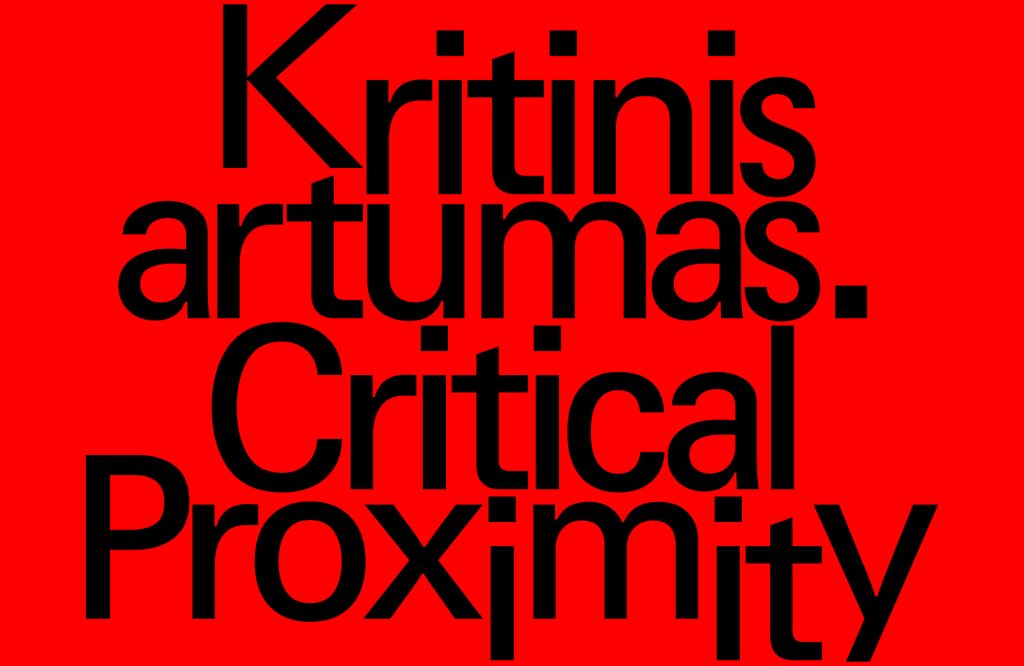
This month Contemporary Art Centre (CAC) Reading Room launches ‘Critical Proximity’, a new series of public lectures, talks and discussions.
The ‘Critical Proximity’ series invites us to reflect on the discourses and themes that inevitably accompany contemporary art. Against the backdrop of today’s crises, contemporary art is inseparable from the circumstances in which it emerges, and these circumstances become an important factor in how it is perceived and the influence it has. These range from the physical and material conditions in which art exists to the technologies and social dynamics that permeate everyday life – not just art – and reveal how authority and legitimacy are determined. They also encompass crisis itself, which has become not merely a rupture in the flow of history but a permanent feature of the contemporary world. These questions emerge through what is created, exhibited, and discussed. In this series, which also marks the general direction of the Contemporary Art Centre’s public programme, we invite people to engage, understand and reflect together.
Contemporary art here serves as a vehicle for discussing the contemporaneity in the broadest sense – a concept that philosophers such as Giorgio Agamben and Peter Osborne theorise, each in their own way, as a ‘present’ that does not coincide with itself. For Osborne, the contemporary is a structure in which individual moments do not coalesce into a whole, and the present is sustained solely by this fictitious construct, which is inevitable under the conditions of globalisation. For Agamben, contemporaneity is instead a position in which we remain at odds with the present by perceiving not only its light but also its darkness – in other words, by engaging with contemporaneity through a critical relationship.
In light of these dynamics, the title of the series also alludes to the modernist assumption that a critical distance is necessary for the perception of art. This assumption can no longer be accepted at face value: there is nowhere left to step back to. What we might wish to observe from the outside also affects us – we are critically close. Bruno Latour proposed ‘critical proximity’ as an alternative to distance, arguing that a gaze from nowhere is not a condition of objectivity, but rather its loss. This reversal becomes significant in the context of this series too: proximity is not a choice, because war, climate change and other crises are also critically close, regardless of how we think about them. We therefore invite you to choose how we might inhabit this proximity while retaining the distance necessary to reflect critically upon it.
The guests in this series will include practitioners – artists and curators – and theorists, as well as representatives from other fields who work with different aspects of the contemporary world, including technology, ecology and current political forms. While discussing each guest’s practice in specific terms, the series will situate it within broader contexts of agency, legitimacy, responsibility and power. Consequently, the series is not limited to the field of art alone; the questions it raises will extend into other parts of the Contemporary Art Centre’s public programme, including lectures, educational initiatives and reading room activities.
– Edvardas Šumila
The first ‘Critical Proximity’ event will be held on 24 September. It will welcome Italian curator Luca Lo Pinto, former artistic director of MACRO – Museum of Contemporary Art of Rome.
EDVARDAS ŠUMILA is a curator and writer based in Vilnius. He trained as a pianist and then as a musicologist at the Lithuanian Academy of Music and Theatre, where he now teaches; in 2013 he founded AHEAD, a festival for electronic sound practices, and went on to direct the contemporary music festival Druskomanija (2015–2018). Since 2023, he has been a curator at the Contemporary Art Centre (CAC) Vilnius, where his projects include Piotr Bury Łakomy’s Garden Exit (2025), the Jonas Mekas–Verdi Requiem (2024), realised with the Lithuanian National Opera and Ballet Theatre and the Centre Pompidou, and the film programme Different Will: The Films of Palestine (2023). He is completing a doctorate in philosophy at the New School for Social Research, where his dissertation concerns the political commitment of art in a time of permanent crisis. His writing has appeared in e-flux Notes, Glissando, Echo Gone Wrong, and other outlets, and the issue of Escape as a Journal he guest-edited on M. K. Čiurlionis (Lithuanian Culture Institute) received an Art Criticism Award in 2026.