One of the longest running projects of the Contemporary Art Centre (CAC) in Vilnius is the Baltic Triennial. Its rich history dates back to 1979, predating the establishment of the CAC itself. Originally conceived as a triennial for young Baltic artists, it was presented at the Palace of Exhibitions in Vilnius. Following Lithuania’s regained independence in 1990 and the reorganisation of state institutions, the CAC was founded, taking over both the Palace of Exhibitions and the continuity of the Baltic Triennial. Since its 6th edition in 1995, the CAC has shaped the project into one of the most significant contemporary art events in the Baltic region.
Each edition of the Baltic Triennial is curated by different curators and presents artists from across the world. The most recent edition took place in 2024 and marked the 15th Baltic Triennial, curated by Tom Engels and Maya Tounta. The project recently reached its final chapter with the launch of the two-volume publication Remain in Zero / Same Day, extending the 15th Baltic Triennial beyond its exhibitions and events by tracing its development across 2023–2024. The publication documents ‘Prologue to the 15th Baltic Triennial: Remain in Zero’ and ‘15th Baltic Triennial: Same Day’. Its launch took place at Sapieha Palace, a branch of the CAC, and was accompanied by a curators’ readings and a piano programme performed by pianist Han-Gyeol Lie.
As the CAC adds this book – featuring photographic sequences by Saulė Gerikaitė and Adrianna Glaviano – to its growing library, the Centre now begins to write a new edition of the Baltic Triennial by announcing the curators of the 16th Baltic Triennial.
As in previous editions, the selection process was invitation-based. On this occasion, candidates and ultimately the appointed curators were selected by a seven-member international committee comprising Valentinas Klimašauskas (Chair of the Selection Committee, Director, CAC, Vilnius, Lithuania), Virginija Januškevičiūtė (currently Senior Curator, CAC, Lithuania), Edgaras Gerasimovičius (Head of Art Programme at Sapieha Palace, a branch of CAC Vilnius), Inga Lāce (Chief Curator, Almaty Museum of Arts), Maria Arusoo (Director, CCA, Tallinn, Estonia), Sebastian Cichocki (Senior Curator, Museum of Modern Art, Warsaw, Poland), and Cosmin Costinas (Senior Curator of Exhibition Practices, Haus der Kulturen der Welt, HKW, Berlin).
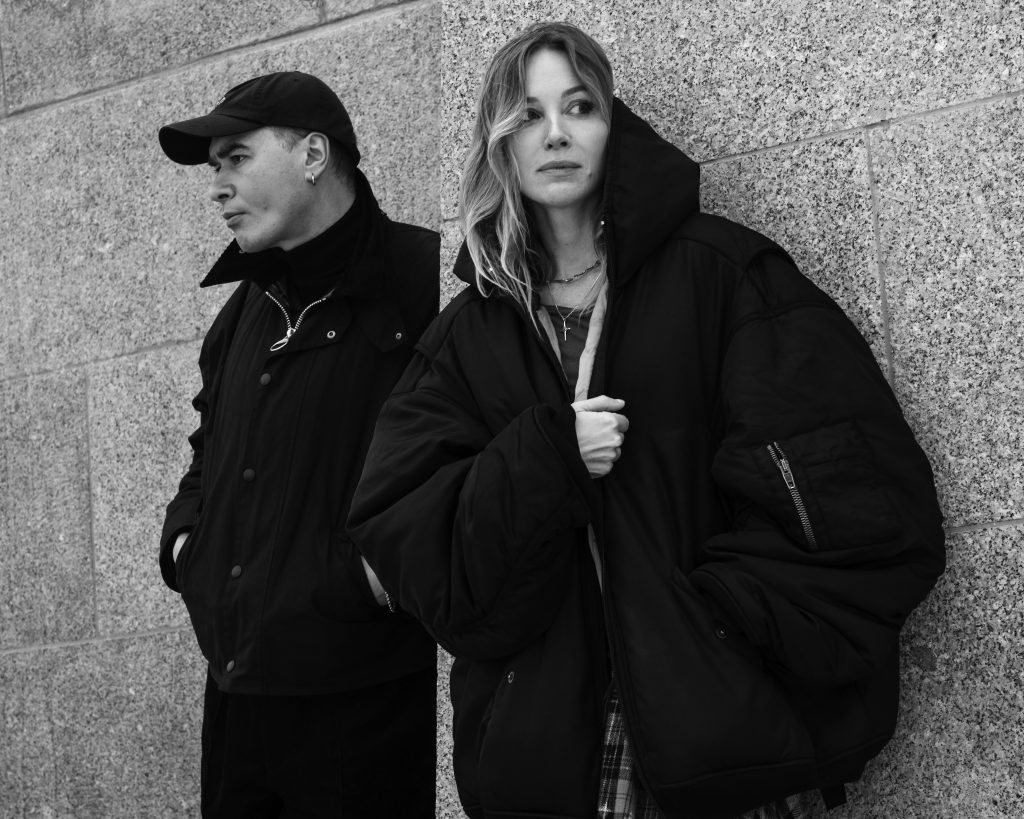
The committee selected artist NIKITA KADAN and art historian and writer NATALIA SIELEWICZ, currently Chief Curator at the Museum of Modern Art in Warsaw, to lead the artistic vision of the 16th Baltic Triennial. Commenting on the selection, Valentinas Klimašauskas said: ‘The curators were selected to provide space for experimentation, dialogue, and sensitivity towards the larger region. Nikita and Natalia were chosen for their ability to create a sensitive, open, and critical conversation with art, history and the public.’
Regarding their proposal for the upcoming edition, the curators write:
‘Arising from an ongoing dialogue on grief and resurrection that has come to mark our friendship, we reflect on what it means to live after an event that breaks the continuity of meaning – when experience, language, and the world itself are altered at their foundations.
We speak from within a position that is itself unstable. As artists who sometimes curate, and as curators unsure where our creative practice ends, we wish to occupy a double position that unsettles fixed definitions and singular authority. Our roles are relational and continually negotiated, shaped as much by doubt and listening as by intention.
From this position, we propose an exhibition that approaches despair and mourning not as pathologies, but as spaces of careful listening. Inhabiting despair thus becomes a form of fidelity: an attunement to the faint echoes of what might yet return, to the resonance of hope that lingers beneath lament, and to the quiet call of what has withdrawn—awaiting those who can still hear it.’
– Curators Nikita Kadan and Natalia Sielewicz
Traditionally, each Baltic Triennial includes a prologue event one year before the main exhibition. The prologue to the 16th Baltic Triennial will take place in mid-2026, offering a first glimpse of how the themes of the upcoming exhibition will be explored affectively, visually, and conceptually.
NIKITA KADAN is an artist based in Kyiv. His work focuses on past trauma and everyday survival in Ukraine, with a particular interest in collective memory and historical politics. Since 2022, his practice has explicitly addressed the war in Ukraine. Kadan has also curated number of projects, including ‘Tryvoha’, presented in the basement of Kyiv’s Voloshyn Gallery, converted into a bomb shelter during the first months of the full-scale Russian invasion in 2022, and ‘Looking into the Gaps I–IV’ (2024–26), a travelling and evolving exhibition, realised across Kyiv, Dnipro, Lviv, Sokołowsko, Berlin, Teshima and Tokyo, dedicated to interrupted narratives within Ukrainian art.
NATALIA SIELEWICZ is an art historian and writer, currently serving as Chief Curator at the Museum of Modern Art in Warsaw. Over the past ten years, she has curated numerous exhibitions at the museum, most recently ‘Maria Jarema. Cracked Modernism’ (2026, with Éric de Chassey). In 2026, she will curate the Estonian Pavilion at the 61st Biennale di Venezia, presenting the artist Merike Estna. Her writing and curatorial practice often interrogate feminism, affective politics, and the technological conditions shaping contemporary subjectivity.
Photo: Nikita Kadan, Natalia Sielewicz
Photographer: Karol Grygoruk